SKIP TO CONTENT

From Danger to Defense – The Power of Venturi Scrubbers in Food Processing

Food recalls are occurring with increasing frequency and expense, creating substantial financial and reputational challenges for food companies. The costs – both direct and indirect – continue to climb, driven by factors like faster production processes, and regulatory oversight.

Tackling the Issues: Product Quality and Cross-Contamination

Fine particulate removal remains a persistent challenge in food processing, especially when handling ingredients like flour, powdered milk, spices, sugar, and starches. The processing and transfer of these materials commonly generate fine dust and particulate matter, which can remain airborne or settle on surfaces, creating risks for product quality, worker safety, and regulatory compliance.

Food Recall Infographic

Enter the Venturi Scrubber: Revolutionizing Air Pollution Control

Venturi scrubbers are advanced wet scrubbing systems engineered to remove fine particulate matter, and gases in industrial exhaust streams. They operate by channeling polluted air through a narrow “Venturi throat,” mixing forcefully with a liquid spray. The resulting turbulence maximized contact between pollutants and droplets, efficiently capturing particulate before releasing clean air. Wet Scrubbers Enviro Air

Key Benefits of Venturi Scrubbers

Advantages Description
Optimal Particle Removal Exceeds 99% for fine and ultra-fine particulates
Versatile Process Handling Effective with hot, moist and particle-rich exhaust
No No
Enhanced Safety No danger of fire or explosion linked to combustible dusts
Superior engineering Less maintenance, minimal downtime
Customizable Adapts to process needs and contaminant types

EnviroAir’s Venturi scrubbers are widely utilized beyond the food processing sector; industries such as chemical manufacturing, power generation, and metal processing frequently depend on this technology for its ability to control a broad spectrum of pollutants, including fine particulate matter, grease removal, and hazardous gases. Their high removal efficiency and versatility make them essential for facilities facing stringent air quality standards and diverse emission challenges.

Since 2001, EnviroAir has collaborated with companies nationwide to address complex industrial air pollution control challenges. By providing advanced dust extraction, air filtration, and comprehensive air quality solutions, EnviroAir technologies help support safe workplace conditions, advance product quality, and help our clients achieve regulatory compliance.

Looking to improve your facility’s air quality? Discover how EnviroAir’s innovative solutions can address your unique challenges. Contact us at 262.594.5891 or Contact Enviro Air
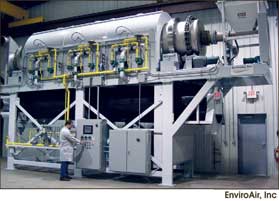
New Rotary Borings Dryer Released

EnviroAir today announced new technology to meet the demands of smaller foundries and metal recyclers. The Model BD-5 Rotary Borings Dryer has the capacity to dry and de-oil 5 cubic feet/hr of metal chips from a variety of machining operations.

The company has already slated the first system to be developed for a brass foundry that had previously purchased EnviroAir Thermal Sand Reclamation Systems.

“We’re pleased that these new product ideas generated from our advanced technology group have led to this important new development”, stated EnviroAir President, Douglas Stenz. “The systems being developed by EnviroAir will address the growing concern for meeting the challenging environmental regulatory demands”.

As part of the project, EnviroAir also engineered a comprehensive Air Quality Control System developed to treat exhaust gases from the Rotary Borings Dryer. The equipment includes a compact, high-efficiency cyclone for particulate control and a compact recuperative thermal oxidizer for destruction of oil vapor in the exhaust gases.

EnviroAir Delivers Advanced Technology to Mexico

EnviroAir recently announced the shipment of its new Rotary Borings Dryer system to an aluminum castings foundry in Mexico that services the automotive industry.

The Model BD-300 has the capacity to dry and de-oil 10,000 lbs/hr of aluminum chips from machining operations enabling them to be safely remelted in the foundry. This is the second BD-300 Rotary Borings Dryer that EnviroAir has supplied to this customer.

EnviroAir also furnished the auxiliary equipment required for a complete chip processing system including conveyors, bucket elevators, chip wringers, chip storage silo, magnetic separator and vibratory fines separator. Also provided was an advanced Air Quality Control System for treating the exhaust gases from the rotary borings dryer. This system included a recuperative thermal oxidizer for destroying the oil vapor in the exhaust gases and equipment for capturing particulate in the exhaust gases.

Equipment Spotlight: Sweat Furnaces

To a recycler, an object such as an automobile transmission resembles a piece of candy in which the wrapper is more desirable than what’s inside. The aluminum of the casing is more valuable than the steel gears and other contents it holds. But most recyclers find that manually separating such transmission cases from their contents is usually prohibitively costly.

For these recyclers, sweat furnaces offer an effective and affordable way to separate non-ferrous metals such as aluminum from less-valuable iron and steel. Sweat furnaces heat commingled recyclable metals to a temperature that causes the non-ferrous metals to melt and run off, leaving behind steel and other materials that melt at higher temperatures.

At sweat furnace maker EnviroAir, Inc. in Eagle, Wisconsin, CORECO Product Manager Dean Lesch said modern machines like those his company makes provide several appealing features. Compared to traditional sloping hearth sweat furnaces, recyclers don’t need to manually rake off iron and other non-melting contaminants. They also avoid impinging flames directly on molten aluminum, which creates dross. Other designs may also allow iron to dissolve into aluminum. Most importantly, up-to-date equipment meets ever-tougher environmental regulations. Read more