SKIP TO CONTENT

Bet on Proof, Not Promises

EnviroAir’s In-House Testing Facility Uses Your Own Sand to Guarantee Performance

For foundry facilities, capital expenses are large, long-term investment that affect operations for years, pre-purchase testing is essential for sustainable growth. The goal is to ensure your expenditure delivers measurable impact with high confidence before committing to finite funds.

A sand reclamation system is an example of a quick payback for your operation. By validating performance before you invest, with your actual material, we lower your risk and give your team real data to compare operations – so you’re investing in results, not claims. For foundries driving sustainability goals, your testing shows exactly how much waste reduction and sand reuse you can achieve, strengthening both your ROI and Environmental case.

Because each foundry’s sand is unique, spent sand can vary significantly, based on the metals cast, binding materials used, and production processes. Testing your own spent sand can ensure that EnviroAir’s system is properly calibrated to your specific materials. This not only proves the system will deliver the promised benefits with high confidence before a foundry commits to allocating funds for the equipment.

WHY IT MATTERS WHAT YOU GET
Validation with your actual sand Run your actual foundry sand through the system and see exactly how it performs with your specific binder types, sand composition, and operation conditions. No guesswork.
Data-Driven Decision Making Get hard test results: LOI 9Loss of Ignition), acid demand value, fineness index, grain size distribution.
Quality Confirmation Before Purchase Verify your reclaimed sand properties BEFORE you commit. Proof, not promises.
Avoid Costly Mistakes Prevent investing in a system that doesn’t work with your specific sand/binder mix. This avoids issues with poor casting quality, operational headaches, and wasted capital.
Justification Testing data gives you the facts to prove the system will hit your cost-reduction and quality goals. Make the case to management with confidence.

Although EnviroAir systems have low operating costs (less than $7.00 per ton), testing in their in-house facility will confirm that this applies to your foundry’s specific sand and quantify the actual savings from reduced disposal penalties and virgin sand purchases.

If your foundry is facing costly disposal penalties and growing waste sand stockpiles, contact EnviroAir to test your sand and invest in equipment that meets your specific needs.

Turning Foundry Pain Points into Competitive Advantages

Sand reclamation systems directly address several of the biggest cost, and competitive pressures facing U.S. primary metals – especially foundries – by cutting input costs, lowering waste and emissions, and improving process efficiency.

Cost and Competitiveness

Reclaiming sand reduces purchases of new foundry sand and binders, insulating operations from price volatility and dependence on importing specialty sands, and case studies demonstrate reclaimed-sand yields above 90-95%, delivering significant dollar-per-ton savings when disposal and new-sand costs are combined; the resulting lower recurring material costs per casting improves margins in a sector already squeezed by lobal competition and energy prices, without resorting to offshoring or cheaper labor.

Energy, Efficiency, Uptime

EnviroAir thermal sand reclaimers are engineered for high throughput with low energy requirements. Systems that optimize burnout and classification reduce rework and casting defects, indirectly saving melting and finishing energy that would otherwise be wasted on scrap. EnviroAir systems can also streamline handling through less hauling to disposal and fewer sand deliveries, simplifying logistics and freeing labor for high-value tasks.

Decarbonization & Environmental Pressure

By reusing sand instead of continually purchasing new material and sending spent sand to landfills, reclamation significantly reduces emissions from mining, processing, and transporting virgin sand while also minimizing landfill impacts. Advanced technologies—such as thermal systems—can reduce CO₂ emissions related to sand use and transport by 10–80%.These improvements help U.S. Foundries meet “Buy clean” and customer requirements by demonstrating lower embodied emissions in their cast metal products.

Regulatory and Landfill Constraints

Reclamation dramatically decreases the amount of spent sand requiring disposal – often by 70-90% – which helps relieve pressure in areas facing limited landfill capacity, rising disposal costs, or stricter permitting. By producing less waste and cleaner sand streams, reclamation also supports compliance with air and water regulations concerning dust, leachate, and binder residues – factors receiving increasing attention from regulators overseeing primary metals and casting operations.

See how thermal sand reclamation could reduce your costs, waste, and emissions over time – connect with EnviroAir to review your current process and identify options that make sense for your business.

Boring No More: Turning Chip Waste into Opportunity

Wet, oily aluminum chips are costly to manage, store, and haul – but with the right process, they become more than a safety concern. They become a profit opportunity.

Rotary borings dryers are the preferred solution for operations handling large volumes of oily aluminum or other metal chips feeding into melt shops, where safety, emissions control, and metal recovery rates drive economic performance.

For metal machining and fabrication shops – automotive, aerospace, heavy equipment, or general machining – rotary borings dryers upgrade your chip stream before resale or remelt.

By cleaning and drying scraps, these systems transform waste chips into higher-value feedstock for secondary aluminum operations, often commanding a better price per pound than mixed or contaminated scrap. The result: cleaner chips, higher melt recovery, fewer furnace issues, and more usable metal returned from your machining waste.

Key considerations when selecting a Rotary Borings Dryer

  • Various metal types require specialized processing methods
  • Facilities with high output may benefit from fully automated system
  • Compact, modular system configurations can maximize floor space
  • Seamless integration connects effortlessly with existing equipment, boosting efficiency and operational flow.

If you already generate a steady volume of aluminum chips and have either a buyer who pays more for clean, dry, dense chips or an in-house melting operation that benefits from higher yield and lower energy/emission, the a rotary borings dryer cold be a key enabler that can tip the chips stream from “cost” toward “profit,” when capital and operating costs are carefully tailored to your production volumes and local scrap market.

Ready to see how cleaner chips can boost your bottom line? Visit our website or give us a call to learn more.

Exploring Advanced Options for Industrial Scrubbers

Between Venturi scrubbers and conventional scrubbers in food processing, Venturi scrubbers are widely regarded as more efficient and suitable for food processing emissions control due to their high particulate and mist removal efficiency, robustness with challenging exhaust streams, and lower long-term operating costs despite higher initial energy use from pressure drop requirements.

Listed below are some key points for consideration:

  • Efficiency in Particulate Removal
    Venturi scrubbers achieve very high removal efficiencies, often exceeding 99% for fine and submicron particles and even higher for larger particles. This is due to the high velocity of gas and intense turbulence in the Venturi throat, which atomizes the scrubbing liquid into fine droplets with a large surface-area-too-volume ration. These droplets capture more particles per volume of liquid than convention scrubbers.
  • Operating System and Performance
    Venturi scrubbers force the contaminated gas stream through a converging throat where it meets the scrubbing liquid under high velocity, producing efficient gas-liquid contact and particulate capture. This design also results in minimal maintenance needs because it avoids spray nozzles and has fewer moving parts compared to some conventional designs.
  • Energy and Cost Considerations
    Although Venturi scrubbers usually require a higher pressure drop (meaning a stronger fan and more energy consumptions), they offer lower capital and operating costs overall due to simpler construction, fewer components, and reduced maintenance. The compact design of Venturi scrubbers is an advantage in facilities with space limitations.
  • Adaptability to Food Processing Conditions
    Venturi scrubbers handle moisture and high temperature well, which is common in food processing exhaust streams, such as grease and steam-laden air from cooking operations. Their ability to handle greasy particulate is demonstrated in cases like meat processing plants, where they effectively remove grease and particulate matter.
  • Comparison to Conventional Scrubbers
    Conventional scrubbers, such as spray tower scrubbers, may have lower pressure drops but generally offer lower removal efficiencies for fine particles and mists critical in food processing emissions. Their maintenance can also be more intensive due to potential clogging, especially when greasy or sticky particulates are involved.

To learn more about how Venturi scrubbers provide superior pollutant removal – especially for tackling fine particulates, grease, and moisture in demanding food processing environments, contact EnviroAir for expert guidance at 262.594.5891

From Danger to Defense – The Power of Venturi Scrubbers in Food Processing

Food recalls are occurring with increasing frequency and expense, creating substantial financial and reputational challenges for food companies. The costs – both direct and indirect – continue to climb, driven by factors like faster production processes, and regulatory oversight.

Tackling the Issues: Product Quality and Cross-Contamination

Fine particulate removal remains a persistent challenge in food processing, especially when handling ingredients like flour, powdered milk, spices, sugar, and starches. The processing and transfer of these materials commonly generate fine dust and particulate matter, which can remain airborne or settle on surfaces, creating risks for product quality, worker safety, and regulatory compliance.

Food Recall Infographic

Enter the Venturi Scrubber: Revolutionizing Air Pollution Control

Venturi scrubbers are advanced wet scrubbing systems engineered to remove fine particulate matter, and gases in industrial exhaust streams. They operate by channeling polluted air through a narrow “Venturi throat,” mixing forcefully with a liquid spray. The resulting turbulence maximized contact between pollutants and droplets, efficiently capturing particulate before releasing clean air. Wet Scrubbers Enviro Air

Key Benefits of Venturi Scrubbers

Advantages Description
Optimal Particle Removal Exceeds 99% for fine and ultra-fine particulates
Versatile Process Handling Effective with hot, moist and particle-rich exhaust
No No
Enhanced Safety No danger of fire or explosion linked to combustible dusts
Superior engineering Less maintenance, minimal downtime
Customizable Adapts to process needs and contaminant types

EnviroAir’s Venturi scrubbers are widely utilized beyond the food processing sector; industries such as chemical manufacturing, power generation, and metal processing frequently depend on this technology for its ability to control a broad spectrum of pollutants, including fine particulate matter, grease removal, and hazardous gases. Their high removal efficiency and versatility make them essential for facilities facing stringent air quality standards and diverse emission challenges.

Since 2001, EnviroAir has collaborated with companies nationwide to address complex industrial air pollution control challenges. By providing advanced dust extraction, air filtration, and comprehensive air quality solutions, EnviroAir technologies help support safe workplace conditions, advance product quality, and help our clients achieve regulatory compliance.

Looking to improve your facility’s air quality? Discover how EnviroAir’s innovative solutions can address your unique challenges. Contact us at 262.594.5891 or Contact Enviro Air

Quality by Design

Why Prevention Outperforms Correction

EnviroAir believes that quality is not a checkbox – it’s the backbone of sustainable success.
Integrating it from the start prevents systemic risks, builds trust, and drives efficiency.
Here’s why a proactive quality focus matters.

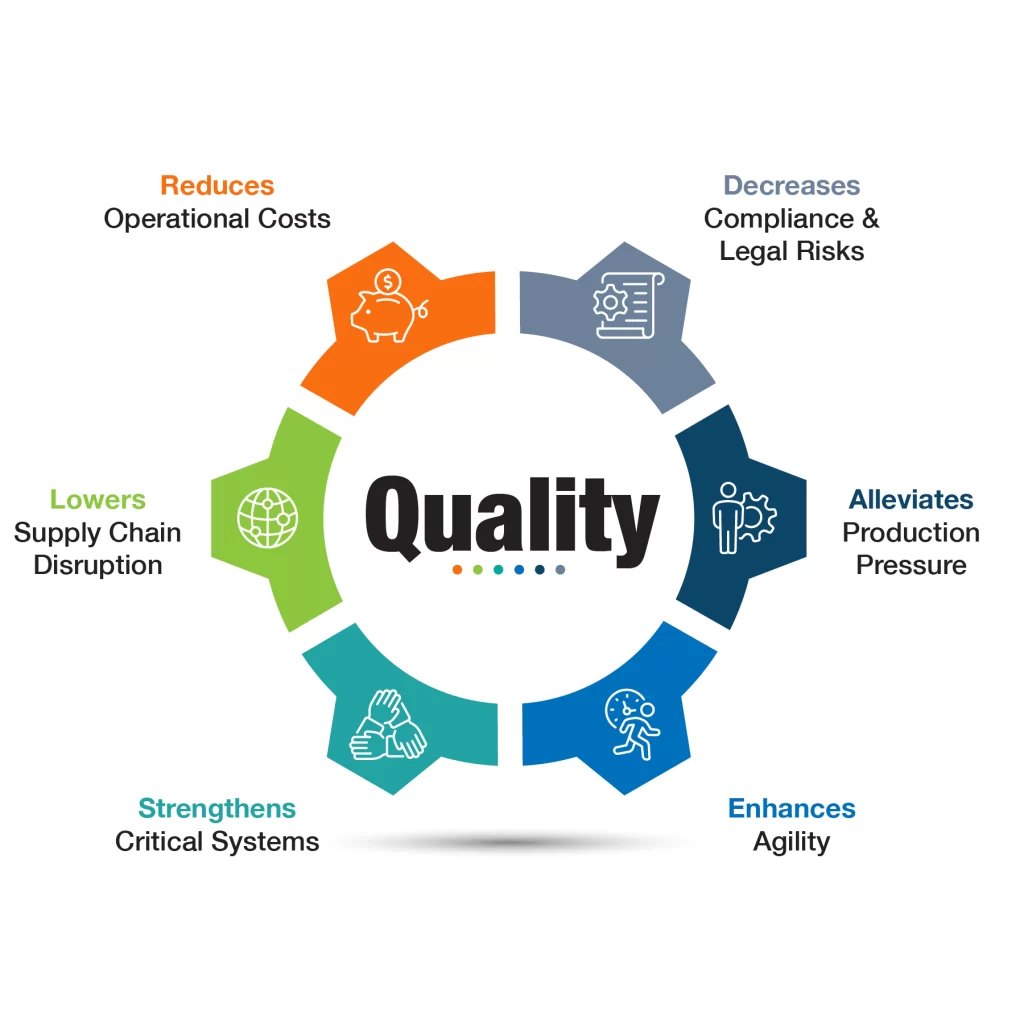
  1. Reduces Operational Costs: Inefficient production results in rework and scrap, directly inflating expenses. Poor systems compound these costs through inefficient resource allocation and labor hours spent correcting errors.
  2. Decreases Compliance and Legal Risks: Persistent quality issues may lead to regulatory non-compliance, product liability claims, or legal action, especially in industries with strict safety and environmental standards.
  3. Alleviates Production Pressure: Frequent quality issues lower employee morale as workers deal with repetitive rework tasks, while management contends with bottlenecks and delayed deliveries.
  4. Lowers Supply Chain Disruption: Inconsistent material quality from suppliers can halt production lines and strain supplier relationships, creating ripple effects across the manufacturing ecosystem.
  5. Strengthens Critical Systems: Resilient systems withstand crises when quality is embedded. Preemptive testing and risk modeling ensure reliability during high-pressure scenarios.
  6. Enhances Agility: Industrial plants can more effectively adapt, innovate, and achieve long-term goals when faced with unexpected challenges.
An infographic showing quality surrounded by the benefits from the numbered list in the article text

Quality is a cultural imperative at EnviroAir, making future-proof operations, building customer loyalty, and driving meaningful innovation for our customers. It balances immediate costs with long-term profitability, compliance, and sustainability for any manufacturing facility.

By emphasizing technical specifications, lifecycle costs, and bidder qualifications, industrial facilities searching for environmental equipment can avoid low bids that risk equipment reliability and costly disruption of production.

Foundry Sand and Waste Foundry Sand (WFS) Management Solutions

Foundry sand is high-quality uniform silica sand used to make molds and cores for ferrous and nonferrous metal castings. Like many industries, the foundry and metal casting industry face several challenges due to increasing global competition, stringent environmental regulations, emissions, and waste, resulting in sustainability performance issues.

Approximately 100 million tons of Waste Foundry Sand (WFS) is annually generated worldwide by the foundry industry, with approximately 6 to 10 million tons of spent foundry sand generated annually in the United States. Unfortunately, less than 15% of this spent sand in the U.S. is recycled.

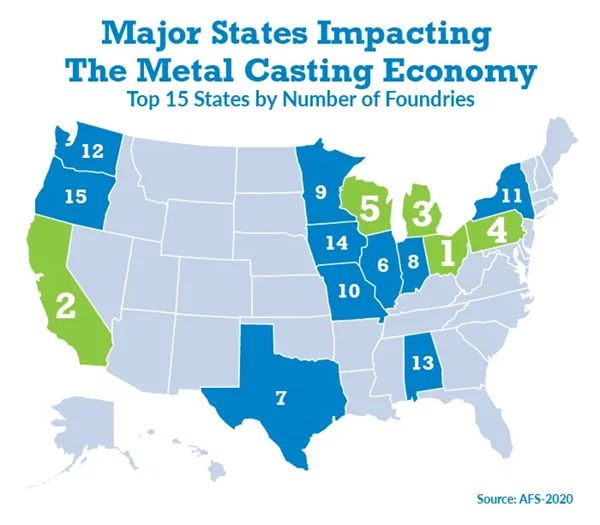
Infographic of a US Map depicting states with the largest number of foundries 1 Ohio 2 California 3 Michigan 4 Pennsylvania 5 Wisconsin 6 Illinois 7 Texas 8 Indiana 9 Minnesota 10 Missouri 11 New York 12 Washington 13 Alabama 14 Iowa 15 Oregon

There are many issues surrounding this industry. A key issue impacting foundries is the growing capacity and management of stockpiled waste foundry sand (WFS) as it requires costly space for accumulation. Additionally, there remains a substantial environmental risk associated with stockpiled waste foundry sand due to an increased rate of toxic metal leaching from the WFS. EnviroAir offers solutions to repurpose waste foundry sand through its sand reclamation systems and reduce the need to expand storage capacity and improve production time.

Strict regulations designed to support the industries’ commitment to improve recycling to support the zero-waste goal identify landfills as not the best alternative for dumping. Without efficient technology, foundries are subject to costly disposal penalties that can greatly reduce their profit margins. EnviroAir’s Thermal Sand Reclamation process meets this challenge.

With energy costs impacting approximately 15% of foundry production, companies need to utilize the most energy-efficient technologies in order to receive substantial reductions in cost and harmful greenhouse gas emissions. EnviroAir’s vision is for the future. We continually strive to set the standard for innovative engineering and excel at environmental performance for a wide range of industries. Each and every day, we work hard to improve the impact we have on the manufacturing industry, the environment, and all our clients.

Throughout its 23-year history, EnviroAir has become a leader in developing innovative solutions that process waste sand in the most efficient, cost-effective, and environmentally sustainable way. EnviroAir’s Thermal Sand Reclamation Systems have been proven to reduce the purchase amount of virgin sand, limit excessive waste sand going to landfills, and substantially decrease associated transportation costs. Additional benefits include:

  • Low operating cost – less than $7.00 per ton
  • Stronger molds and cores
  • Improved casting quality
  • Fully automatic system – minimal manpower to operate
  • Robust, simple design – low maintenance
  • No cooling tower to maintain

Understanding the best technology for each client’s unique production needs has been the foundation of EnviroAir’s success and ultimately, the production success of our clients. We offer six thermal sand reclamation models ranging from ¼ to 6 tons per hour. All projects receive expert guidance and the support of experienced engineers to help clients select the most appropriate technological approach for their projects.

Transcript EnviroAir Streamline Operations Drive Innovation Improve Environmental Success Achieve Environmental Sustainability

Now, spent foundry sand can be reclaimed and reused safely, saving energy, and reducing the need for mining virgin materials. An EnviroAir Engineer is here to discuss your options as well as the benefits behind them for your company. Contact EnviroAir Today at 262-594-5891 for more information.

Advancements Made to Paper Trap Technology

EnviroAir recently introduced improvements to their patented, self-cleaning paper trap. The paper trap captures tissue broke collected at our dust capture hoods and floor sweeps to prevent the tissue broke from plugging downstream dust collectors.

EnviroAir saw the need for further improvements when they discovered newer tissue grades were not cleaning as well from paper trap media.

The new paper trap improvements include a re-engineered media design with larger openings and new blow-off nozzle design to enhance the strength air jets in the system.

New Rotary Borings Dryer Released

EnviroAir today announced new technology to meet the demands of smaller foundries and metal recyclers. The Model BD-5 Rotary Borings Dryer has the capacity to dry and de-oil 5 cubic feet/hr of metal chips from a variety of machining operations.

The company has already slated the first system to be developed for a brass foundry that had previously purchased EnviroAir Thermal Sand Reclamation Systems.

“We’re pleased that these new product ideas generated from our advanced technology group have led to this important new development”, stated EnviroAir President, Douglas Stenz. “The systems being developed by EnviroAir will address the growing concern for meeting the challenging environmental regulatory demands”.

As part of the project, EnviroAir also engineered a comprehensive Air Quality Control System developed to treat exhaust gases from the Rotary Borings Dryer. The equipment includes a compact, high-efficiency cyclone for particulate control and a compact recuperative thermal oxidizer for destruction of oil vapor in the exhaust gases.

EnviroAir Delivers Advanced Technology to Mexico

EnviroAir recently announced the shipment of its new Rotary Borings Dryer system to an aluminum castings foundry in Mexico that services the automotive industry.

The Model BD-300 has the capacity to dry and de-oil 10,000 lbs/hr of aluminum chips from machining operations enabling them to be safely remelted in the foundry. This is the second BD-300 Rotary Borings Dryer that EnviroAir has supplied to this customer.

EnviroAir also furnished the auxiliary equipment required for a complete chip processing system including conveyors, bucket elevators, chip wringers, chip storage silo, magnetic separator and vibratory fines separator. Also provided was an advanced Air Quality Control System for treating the exhaust gases from the rotary borings dryer. This system included a recuperative thermal oxidizer for destroying the oil vapor in the exhaust gases and equipment for capturing particulate in the exhaust gases.