SKIP TO CONTENT

Boring No More: Turning Chip Waste into Opportunity

Wet, oily aluminum chips are costly to manage, store, and haul – but with the right process, they become more than a safety concern. They become a profit opportunity.

Rotary borings dryers are the preferred solution for operations handling large volumes of oily aluminum or other metal chips feeding into melt shops, where safety, emissions control, and metal recovery rates drive economic performance.

For metal machining and fabrication shops – automotive, aerospace, heavy equipment, or general machining – rotary borings dryers upgrade your chip stream before resale or remelt.

By cleaning and drying scraps, these systems transform waste chips into higher-value feedstock for secondary aluminum operations, often commanding a better price per pound than mixed or contaminated scrap. The result: cleaner chips, higher melt recovery, fewer furnace issues, and more usable metal returned from your machining waste.

Key considerations when selecting a Rotary Borings Dryer

  • Various metal types require specialized processing methods
  • Facilities with high output may benefit from fully automated system
  • Compact, modular system configurations can maximize floor space
  • Seamless integration connects effortlessly with existing equipment, boosting efficiency and operational flow.

If you already generate a steady volume of aluminum chips and have either a buyer who pays more for clean, dry, dense chips or an in-house melting operation that benefits from higher yield and lower energy/emission, the a rotary borings dryer cold be a key enabler that can tip the chips stream from “cost” toward “profit,” when capital and operating costs are carefully tailored to your production volumes and local scrap market.

Ready to see how cleaner chips can boost your bottom line? Visit our website or give us a call to learn more.
Exploring Advanced Options for Industrial Scrubbers

Between Venturi scrubbers and conventional scrubbers in food processing, Venturi scrubbers are widely regarded as more efficient and suitable for food processing emissions control due to their high particulate and mist removal efficiency, robustness with challenging exhaust streams, and lower long-term operating costs despite higher initial energy use from pressure drop requirements.

Listed below are some key points for consideration:

  • Efficiency in Particulate Removal
    Venturi scrubbers achieve very high removal efficiencies, often exceeding 99% for fine and submicron particles and even higher for larger particles. This is due to the high velocity of gas and intense turbulence in the Venturi throat, which atomizes the scrubbing liquid into fine droplets with a large surface-area-too-volume ration. These droplets capture more particles per volume of liquid than convention scrubbers.
  • Operating System and Performance
    Venturi scrubbers force the contaminated gas stream through a converging throat where it meets the scrubbing liquid under high velocity, producing efficient gas-liquid contact and particulate capture. This design also results in minimal maintenance needs because it avoids spray nozzles and has fewer moving parts compared to some conventional designs.
  • Energy and Cost Considerations
    Although Venturi scrubbers usually require a higher pressure drop (meaning a stronger fan and more energy consumptions), they offer lower capital and operating costs overall due to simpler construction, fewer components, and reduced maintenance. The compact design of Venturi scrubbers is an advantage in facilities with space limitations.
  • Adaptability to Food Processing Conditions
    Venturi scrubbers handle moisture and high temperature well, which is common in food processing exhaust streams, such as grease and steam-laden air from cooking operations. Their ability to handle greasy particulate is demonstrated in cases like meat processing plants, where they effectively remove grease and particulate matter.
  • Comparison to Conventional Scrubbers
    Conventional scrubbers, such as spray tower scrubbers, may have lower pressure drops but generally offer lower removal efficiencies for fine particles and mists critical in food processing emissions. Their maintenance can also be more intensive due to potential clogging, especially when greasy or sticky particulates are involved.

To learn more about how Venturi scrubbers provide superior pollutant removal – especially for tackling fine particulates, grease, and moisture in demanding food processing environments, contact EnviroAir for expert guidance at 262.594.5891

Quality by Design

Why Prevention Outperforms Correction

EnviroAir believes that quality is not a checkbox – it’s the backbone of sustainable success.
Integrating it from the start prevents systemic risks, builds trust, and drives efficiency.
Here’s why a proactive quality focus matters.

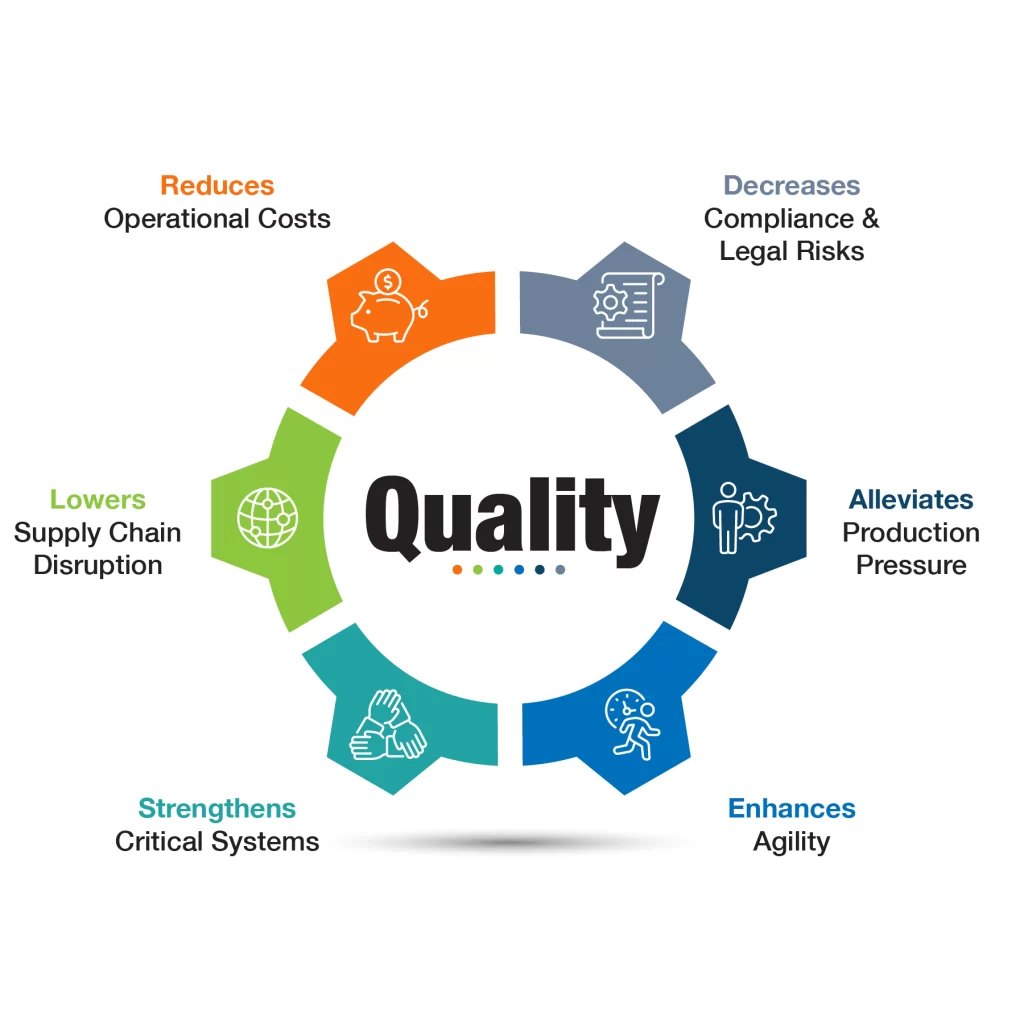
  1. Reduces Operational Costs: Inefficient production results in rework and scrap, directly inflating expenses. Poor systems compound these costs through inefficient resource allocation and labor hours spent correcting errors.
  2. Decreases Compliance and Legal Risks: Persistent quality issues may lead to regulatory non-compliance, product liability claims, or legal action, especially in industries with strict safety and environmental standards.
  3. Alleviates Production Pressure: Frequent quality issues lower employee morale as workers deal with repetitive rework tasks, while management contends with bottlenecks and delayed deliveries.
  4. Lowers Supply Chain Disruption: Inconsistent material quality from suppliers can halt production lines and strain supplier relationships, creating ripple effects across the manufacturing ecosystem.
  5. Strengthens Critical Systems: Resilient systems withstand crises when quality is embedded. Preemptive testing and risk modeling ensure reliability during high-pressure scenarios.
  6. Enhances Agility: Industrial plants can more effectively adapt, innovate, and achieve long-term goals when faced with unexpected challenges.
An infographic showing quality surrounded by the benefits from the numbered list in the article text

Quality is a cultural imperative at EnviroAir, making future-proof operations, building customer loyalty, and driving meaningful innovation for our customers. It balances immediate costs with long-term profitability, compliance, and sustainability for any manufacturing facility.

By emphasizing technical specifications, lifecycle costs, and bidder qualifications, industrial facilities searching for environmental equipment can avoid low bids that risk equipment reliability and costly disruption of production.